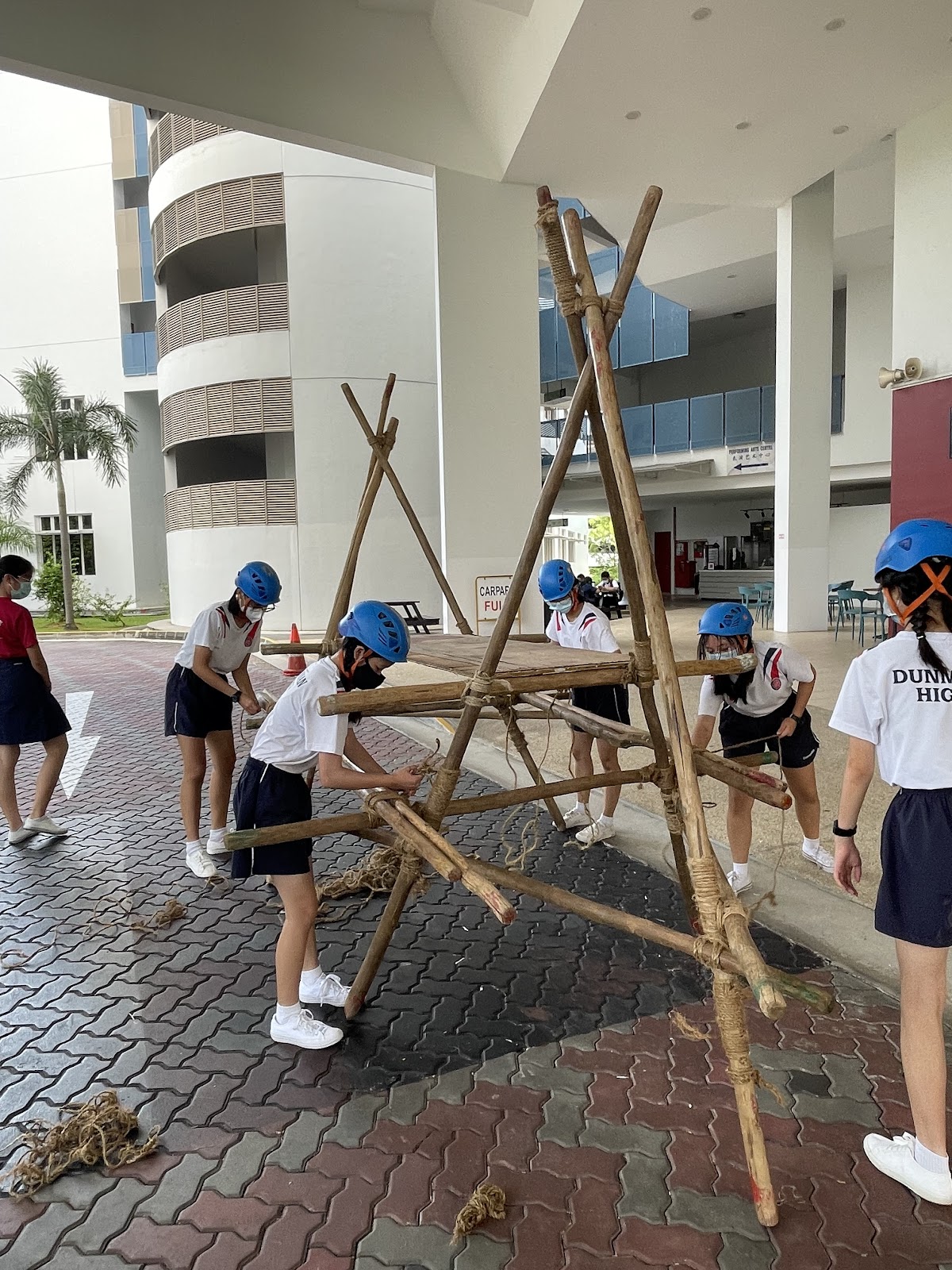
For today's 集合,the Year 1s and 2s built a Kitchen Shelter while the Year 3s built a Kitchen Table, followed by Batch Activity, Mass Change, and Obstacle Journey.
Kitchen Shelter:
This activity aims to help the Year 1s and 2s revise on their hard skills and the steps on how to build a Kitchen Shelter. This activity also allows the Year 2s to step up to look at the bigger picture, as there was assigned PL and PS. This is especially important for them to hone their leadership skills.
Reflection from a Year 1:
On Tuesday, my patrol made a Kitchen Shelter. Since it was the first time we were building it without the Year 3s we were a bit nervous about building it. Since there were not enough canvas sheets, 2 patrols had to combine together to build the shelter. With so many people building one Kitchen Shelter, we still distributed our manpower well. I was tasked to 顶 the 红木 with my patrol mate and standing there under the sun while trying to make the spars stand in place was not an easy job. We also failed to allocate manpower properly and some of us forgot how to 打进 the arthurs, which slowed our progress. When we chou-ed the 麻绳 to lift up the shelter, we also faced minor difficulties such as the difference in the strength used in chou-ing the 麻绳 and knots on the 麻绳 which made it impossible to pull through the 活结. Our patrol and patrol 2 ended up being the only ones who completed our kitchen shelter in time. When we 集合-ed after building the Kitchen Shelter, one of the members from patrol 2 did not feel very well which made me learned to stay hydrated and take care of myself regardless of what activity I am participating in, especially when we are doing it under the hot sun. Even though the Kitchen Shelter was slanted and was not upright, I am still proud of completing the Kitchen Shelter in time without the year 3s. We could have improved on managing our time as we asked for a few time extensions and even though we managed our manpower well there were still instances where there were a bunch of people crowding at the same area which was a waste of manpower. Overall the activity was fun as our hard work paid off.
Reflection from a Year 2:
During 集合 on 31 May, we were separated from our Year 3s and were left with the Year 1s to build a kitchen shelter. It was our second time building a Kitchen Shelter and we were quite nervous and unprepared as we had to step up more to lead the Year 1s in building the Kitchen Shelter. We were not very confident since it was only our second time and we did face some difficulties, but this could have been improved if we revised on how to build the structure earlier. For example, we were not sure what to tie and where to tie the knots and lashes. We also did not know the exact steps to attach the 深蓝木 to the 红木. The Year 4s had to lend us a helping hand so that we could get the structure up. We faced some problems such as there was a hole in the canvas sheet and we had to waste time getting duct tape from 团部. We 过时-ed quite a lot and we took more than 1 hour to get the main guylines lines up and we were not really close to completing the structure despite 过时-ing for quite long. There was also little sense of urgency especially since we took very long to tie the 火结 and prepare to 抽. Overall, I felt that we could have done better and we could have improved by better allocating our manpower and communicating better. For example, we had two people taking the pacings from both sides as we did not properly communicate on who was supposed to do the pacings. There were also a lot of people just standing around so the manpower could have been allocated better so that the Kitchen Shelter could be completed as soon as possible. But I think some good points were that we still could remember the basics on how to build a Kitchen Shelter, and we encouraged and took care of each other's well-being.


Kitchen Table:
This activity aims to help the Year 3s recap on how to build a Kitchen Table. In addition, they were required to complete the Kitchen Table within the allocated timing, which helped them to have a better sense of urgency. The assigned PL and PS were also provided opportunities to step up, to help them prepare for their upcoming journey as the next 领导层.
Reflection from a Year 3:
For the first half of 集合 on 31 May, we were split into our individual batches and put into different groups to complete a Pioneering and Gadgeting task. For the Year 3s, we were tasked to build a Kitchen Table within 40 minutes. Although we had much experience in the theoretical and practical part of building the Kitchen Table as we had done so many times, we were very slow during the collection of logistics and building the Kitchen Table itself. We did not live up to the standards that our seniors had set for us and had to keep asking for time extensions to complete the activity. This was rather disappointing for us as we knew we had the potential to have a greater sense of urgency, but we did not show it. As we were in different groups from our usual patrol mates with different assigned Patrol Leaders and Patrol Seconds, the manpower allocation and communication might not have been optimal, causing the Kitchen Table to be built quite slowly. As morale was not very high, we could have cheered more as a group and a 团, so that we could increase the morale of the entire 团 which would help us build a better Kitchen Table in a shorter time. In addition to our soft skills, our hard skills such as the tightness of our lashes could be improved. We had to 重抽 and re-tie a lot of our lashes as they were not as tight as it should be, considering how long we have been in Guides. This was highly concerning as we are going to step up to be the next 领导层 and we want to set a high standard of lashes for our juniors and be good examples for them to follow. Nearing the end of the activity, as Group 3 was not done with their Kitchen Table, members from Group 1 and 2 went over to help them complete the last few lashes. This was quite heartwarming as it showcased a 团 spirit and our teamwork. Overall, although the process of building the Kitchen Table could have been improved, the result was good as all the groups completed their structure.


Year 1 Batch Activity: Lash Training and Standard Gadgeting
The Year 1s were able to take this opportunity to revise on their hard skills such as the basic lashes (square lash, diagonal lash, A-架 lash) and also how to tie a standard baggage rack. They were able to clarify their doubts about the lashes, and make sure that they were all tying their lashes correctly.
Reflection from a Year 1:
During the Batch Activity, we made a baggage rack. Before making the baggage rack we had to collect the logistics from 团部. However, there were not enough logistics for the entire batch so we had to substitute some logistics with other similar ones. As it was our first time having a batch activity, it was a bit tough to remember all the logistics and collection of logistics was also a bit chaotic, but all in all we managed to get everything we needed. When we returned to the venue our seniors informed us that we would be building baggage racks in groups of two patrols each. Some challenges that we faced here are that we were not very familiar with the structure and had to keep checking the diagram and sometimes our lashes may not be up to standard. We also found it hard to finish the structure on time and we needed multiple time extensions, after which we were still unable to finish due to a lack of urgency and it being our first time building a baggage rack without seniors. The batch activity was a good opportunity for us to step up and lead our groups to fulfilling the goal as we had to complete this activity without our seniors. It was also a way for us to step out of our comfort zones and do things that we would not normally do with our seniors around. Although we did not complete the baggage rack, we have learnt many things from the batch activity. Firstly, allocation of manpower is very important in ensuring everything goes smoothly. Next, we should be more confident in ourselves and try our best to step up and help lead our group to the end goal as a team. Teamwork is a very important thing and it is essential to making sure our final product is stable and functional. All in all, this activity taught us a lot and we will definitely use this knowledge in future 集合s and Patrol Activities.
Year 2 Batch Activity: Standard Gadgeting
For Batch Activity, the Year 2s could revise on more unconventional standard structures such as Emergency Shelter and Flagpole. Since these structures are not as commonly tied during 集合,this session helped them to familiarise themselves with the steps and also clarify their doubts. Less than halfway through the activity, they were also suddenly asked to build a baggage rack, which helped them learn how to adapt to challenges.
Reflection from a Year 2:
During the Year 2 batch activity, I had a lot of fun working together with my batch mates to complete activities. For the emergency shelter and flagpole activity, the Y4s combined our patrols to ensure that we had enough manpower to complete the activity. I managed to get to know my batch mates better and make more friends during the activity. We also got to work on our creativity when we built a creative emergency shelter and flagpole. We had to make good use of our time to complete a task of building both a flagpole that we could not 打进 into the ground and an emergency shelter that did not look like the standard one. We were given limited amounts of 木 and challenges, making the activity even more challenging. During the activity, my group chose to divide into 2 sections to increase productivity, 1 to build the shelter and 1 to make the flagpole. I was part of the flagpole group. At the beginning of the activity, we were having trouble deciding what to build. In the end, because we were running out of time, we decided to just build a tripod and see what we could make with it. In the end, we managed to make a tripod with one 定脚. We attached the flagpole to the 定脚 and it ended up looking like an easel. Despite the unique structure of our flagpole, it was definitely very creative and well structured. The emergency shelter group 打进 2木s into the ground and managed to make a good shelter. Although this activity was quite challenging, with the increased amount of manpower, we were able to make a good flagpole and emergency shelter. Overall, I really enjoyed this activity, which allowed me to gain more teamwork with my batch mates, work on my creativity and time management skills.

Year 3 Batch Activity: Creative Gadgeting
For Batch Activity, the Year 3s did Creative Gadgeting. They were tasked to build a house with a working door using only long 木 and a PVC pipe. This activity helps the Year 3s think out of the box and unleash their creativity through designing their own house structure. In addition, each group was given a different number of logistics, to allow them to improve their communication skills through asking each other for more logistics if necessary.
Reflection from a Year 3:
During 集合 on 31 May, we had Batch Activity, which was Creative Gadgeting. We were separated into 3 groups, and each group had to build a house with a functional door. We also had to use as many 木 as possible, and the storyline we were given stated there was a monster that was afraid of long 木. We had 50 minutes to complete our creative structure. Our group decided to make a house in the shape of a cube, and the door would be more of a “flap door”, as it was easier to make it hang from above, rather than from the side. First, we built two square frames beside each other, and used the square tiles on the floor as markings instead of having someone to measure the length of the frames. This saved us time and allowed us to tie the square frames faster. Due to the lack of 长木, we decided to only tie one diagonal on each frame. Afterwards, we connected the square frames together with 4 中长木, 2 on each side. While some of us were doing that, others also connected a 中木to the PVC Pipe. We then made another square frame using that 中木that was tied to the PVC pipe, and added two diagonals. This would be our flap door. Before connecting one of the upper 中长木 that was at the front of the house, we put the PVC pipe through it. When we were done with our respective assigned tasks, we connected 长木 together, and tied it to our house. However, we ran out of time at the end, and did not manage to complete one of our diagonals for our flap door and connect our long 木 to our house. As this was us Year 3s last 集合 before PDP and we take over our Year 4s as 领导层, we felt that our sense of urgency could definitely have improved in order to complete our structure, and we could have tied additional diagnonals to the frames in the future to ensure a more stable structure. Overall, this was an enriching experience for us to exercise our creativity.


Mass Change:
Before Obstacle Journey began, the Year 2s and Year 3s had to mass change into their OJ kits. This allowed them to train their sense of urgency, and also cooperation as they had to work together in order to make sure everyone came back in the fastest possible time with the proper attire. For example, helping each other fold their shirts or adjust their scarf.
Reflection from a Year 2:
31 May was our last 集合 session with the Y4s and we brought our OJ kits to school. Right after lunch, we had to carry out mass change. Our OJ kits were in the classroom on level 3 and our patrol was assigned the toilet at level 4. We rushed to get our OJ kits and ran upstairs to the toilet. Unfortunately, once I got there, the toilet was already quite full. I quickly found a spot with a hook to hang my OJ Kit such that it would not 动地. My patrolmate helped me adjust my scarf, making sure that it was below the collar of the COY tee. After hanging my PE T-shirt on the hanger, folding it and clipping it, I went down to the classroom to put my hanger before running downstairs to MRL. However, by the time everyone 全到-ed, it was already 21 minutes, triple the original amount of time we were given, which was 7 minutes. This was because some people went to 团部 to take the ponchos for the OJ kit. Some of our OJ kits were not up to standard as well during attire check. As a result, we got knocked down, even the Y1s who did not wear their OJ kit. This made us learn that we have to work together, reminding each other when one’s uniform is not up to standard. It is a collective effort, not just one man for himself. We need to work together, to achieve faster timing and for everyone to have an OJ kit that is up to standard. Overall, this improved our sense of urgency as well as my familiarity with the OJ kit.
Reflection from a Year 3:
Mass change was very rushed and frantic as usual but I feel that it was like a challenge for all of us to be as quick as possible and to push ourselves to change within the time limit. Since we have done mass change many times in the past, I feel that doing mass change for the last time before stepping up as 领导层 is very memorable as we all want to do our best to set a standard for our juniors. Mass change also helps us look out for each other by checking our OJ kit/制服 to make sure it is neat, we also help each other by allocating roles for one person to ask for time extension. Furthermore, mass change made us prioritise our task and as we needed to collect 配备 and 青木 so we allocated our Y1s to collect all the logistics since they did not need to change. We also need to communicate with other patrols to ensure that all the manpower was accounted for as some people may be left in the toilet alone so the QMs need to send someone from the patrol to check on the person in the toilet. Lastly, it was also a good opportunity for us to train both our juniors’ and our sense of urgency. It was also very assuring when we saw that our juniors were getting faster at mass change and helping each other to work faster. However, I still feel that we need to improve on the overall neatness of our 制服s/OJ kit because many people were still in the wrong attire. Overall, I feel that Mass Change was a short but important activity to train all our sense of urgency and help bond us when we look out for each other.
Obstacle Journey
Station 1: First Aid
For this station, the juniors had to treat injuries such as fainting, sprained ankle and shoulder dislocation with their First Aid Skills, and making use of the First Aid Pouch in their 配备. This station aims to help the Year 2s step up more, as some of the Year 3s had to be the "casualties" and could not tie the bandages. It also aims to refresh the juniors' memory and help them recap on their First Aid Skills.
Reflection from a Year 1:
Station 1 was our second last station, however we still had high spirits.
When we heard the information about the station from the Station Master, I was slightly shocked to hear about the First Aid activity, as it had completely slipped my mind that Guides included learning basic First Aid too. Admittedly, we were zuobos in this activity because we really were clueless on what to do. The ‘injuries’ given were loss of consciousness, sprained ankle, dislocated jaw, and shoulder dislocation. I think the easiest part of the bandaging was the broken arm, as there was not a specific technique to tie or wrap. but the jaw and ankle were another story. For the jaw, only one of the Year 2s had an idea of how to tie the bandage, which was better than the rest of us, because all we could do was watch. While watching, the rest of us were tying a sling for the arm, and I tried to help by pulling the bandages down so that the bandages could stay on the casualty's head. However, our tries were to no avail, so the seniors demonstrated how to tie the head bandage. Then,we moved on to the ankle. The ankle bandage felt slightly less foreign as the bandaging techniques were just a few figure eights. We finished up everything that needed bandaging and tying, but it seemed that we had forgotten to address the loss of consciousness. The seniors walked us through the steps to attend to an unconscious person.
This activity was not as fun as the other ones, but it made me realise how important it actually was to learn First Aid properly.
Reflection from a Year 2:
For Station 1, the First Aid station, we learnt more about first aid and through this station, we were reminded of the basic bandages. We learn the right bandages for the different types of injuries that might occur during a scenario such as the one in that station which involved a dislocated shoulder, sprained ankle. For example, for a dislocated shoulder , we were supposed to tie an elevated sling bandage. Through this station, we were reminded of the importance of bandages such as these and the important things to take note when tying these bandages, such as the finger being outside of the bandage which is especially important. We also learnt how to ask for a response from a casualty. The acronym, COWS, stands for can you hear me, open your eyes, what is your name and squeeze my hand , is the guideline for asking for response from casualties. Asking for response from the casualties is important to understand more about the casualties’ well-being and consciousness level to better attend to him or her in response to their consciousness level . We also learnt how to tie a head bandage and bandage for a sprained ankle. Through this station we learnt more about first aid and improved my first aid knowledge . We also learnt more about the importance of first aid . First aid is especially important for survival and is one of the essential skills to be able to take care of oneself and also help others when they are in need in a tight situation. However, I feel that we could have remembered these important knowledge better and also 报时 more often to be able to keep track of our time better. Injuries occurs frequently in out daily lives, hence, I feel that we should definitely improve our first aid knowledge to know exactly how to help others when they are injured. All in all, we learnt much from the first aid station and we feel that this station was definitely helpful to us in reminding us of the basic bandages and first aid skills.
Reflection from a Year 3:
For the First Aid station, we had to treat a shoulder dislocation, sprained ankle and fainting. We tied the bandages and used our knowledge from the Guides notes to treat the fainting. Our bandages were not very neat, so I think we could work on that. The atmosphere was quite lively and I would say it was a great environment to learn. Our juniors were also very enthusiastic which made the morale high and lifted our spirits. This was an opportunity for us as Year 3s to teach our Year 1s First Aid knowledge, as they have only experienced First Aid stations a few times. Although the Year 1s are new and we tend to focus on them more, I think that we still needed to include the Year 2s. Instead of us talking all the time, we could have asked our Year 2s some questions, which would make them feel more involved.I think that we did our best in showing the First Aid skills to the Year 1s and tried to teach them in the easiest and most straight-foward way we could. I am quite grateful for this First Aid station since it recapped most of the common bandages used as well as some knowledge from the Guides notes. I felt it was a good summary of the First Aid knowledge, and it was probably the last time for us to do First Aid with the juniors. We had a lot of fun, and we hope our juniors also found it enriching.


Station 2: Survival Skills
For this station, the juniors had to solve the survival skills and trekking signs post-its, but with a twist as they needed to complete some challenges as a patrol before they could get the post-its to solve. This station aims to promote patrol bonding while also helping to recap on some trekking signs and survival skills such as edibility test.
Reflection from a Year 1:
One of the stations was about survival skills. Survival skills might seem like a pointless endeavour in today’s world. However, It is actually important to make sure everyone has the skills they need for a successful survival, whether it's camping, hiking or facing a real-life emergency. For instance, a twisted ankle on a solo trip or a casualty in a group can change the day into a serious scenario. For this station, we first had to pick a piece of paper with a number that corresponds to a challenge. Some of the challenges we did was singing the 团歌, playing Scissors Paper Stone with the Station Master and having to win 3 consecutively. Afterwards, we will have to answer a question related to survival skills and trekking signs. I felt that we could have revised our Guides Notes more as we stumbled upon some trekking signs which looked familiar but we were unable to name what it represents. However, it was great that we were able to accurately recall the Edibility Test and we also 报时-ed frequently. I also feel that we could have cheered more to boost our patrols morale. In conclusion, I have learnt much from this station such as learning what the trekking signs ,which I was unable to answer, represents. I have also enjoyed doing the challenges with my patrol as we all had some fun and laughter while playing. All and all, I believe that it is very important for people living in modern times to learn the basics of survival. I also hope that we can have such a fun station for future Obstacle Journeys and I will make sure to revise my Guides Notes more.
Reflection from a Year 2:
Station 2, which involved completing a series of challenges before solving trekking signs and answering survival skills questions to obtain a clue, was a particularly interesting station to me. Two of the challenges were related to the game Scissors Paper Stone, where we found out that one patrol member mostly lost in the game. This gave us a good laugh and also helped us learn more about one another. I think that these stations and games always help us to bond and understand one another better in the most subtle ways, sometimes bringing out our past experiences, sometimes bringing out quirky facts, which always brings us a lot of joy and makes the experiences very enjoyable and memorable. Another challenge was to sing the song My Bonnie. Whenever I sing in Guides, I myself am amused as I would never sing in front of others, Guides being the only exception. Maybe it is the fact that everyone has to sing, but in Guides, there is a sense of security for me, which makes the sessions very comforting and allows me to be myself. It was also very comforting to sing as a patrol as it feels like a homey choir. When we reached the part about us dreaming about Bonnie dying, we would also give a small giggle over the dark song, a ‘joke’ only we knew. Lastly, guessing trekking signs and survival questions are always a fun part of challenges as when we revise our Guides notes, we often get mixed up over the vast information, and spout out funny answers. We would also cheer and rejoice when we finally guessed a sign correctly, another memory I will not forget. Overall, station 2 and the day itself was bittersweet for me as it was our last session before Passing Down Parade but also sweet in the fact that we bonded quite a fair bit over the long session, adding more sweet memories and pulling us closer.
Reflection from a Year 3:
After Mass Change, we had Obstacle Journey. One of the stations was the survival skills station, where we had to complete a series of challenges as a patrol, and solve trekking signs and survival skills questions. Each person took turns to pick our a number from a bag, which represented a different challenge. One of these challenges was the game Scissors Paper Stone, where majority of us in the patrol had to win the game in order to complete the challenge, and another challenge was the same game, but we had to win 3 times in a row. Other challenges included singing "Three Little Ducks", a Guides song. After each challenge, we were to answer either a trekking signs or survival skills question. However, as we were still rather unfamiliar with majority of the trekking signs, we were unable to answer most of the questions but I was still able to vaguely answer the survival skills questions. As a Year 3, I feel that I should have better revised my Guides notes in order to help answer the trekking signs questions, unlike when I always relied on my peers to answer them. I felt that this station allowed myself to bond more with my Year 1 and Year 2 juniors, especially while doing the challenges. We had fun while playing the Scissors Paper Stone game and singing songs, and I felt that we grew closer together as a patrol. We would also look nervously at each other when we heard a trekking signs or survival skills question that we did not know how to answer, and one of us would try to guess the answer. When we would guess the right answer, we would cheer and laugh together, which bonded us closer. All in all, I felt that this station, and the other stations in Obstacle Journey were fun and engaging. As this would be my last time actually participating in stations and Obstacle Journey, I felt that this station was particularly memorable and bittersweet. I hope that in the future, I would still be able to create just as, if not more, fun and happy memories with my patrol as I did in this last session before PDP.


Station 3: Obstacle Course
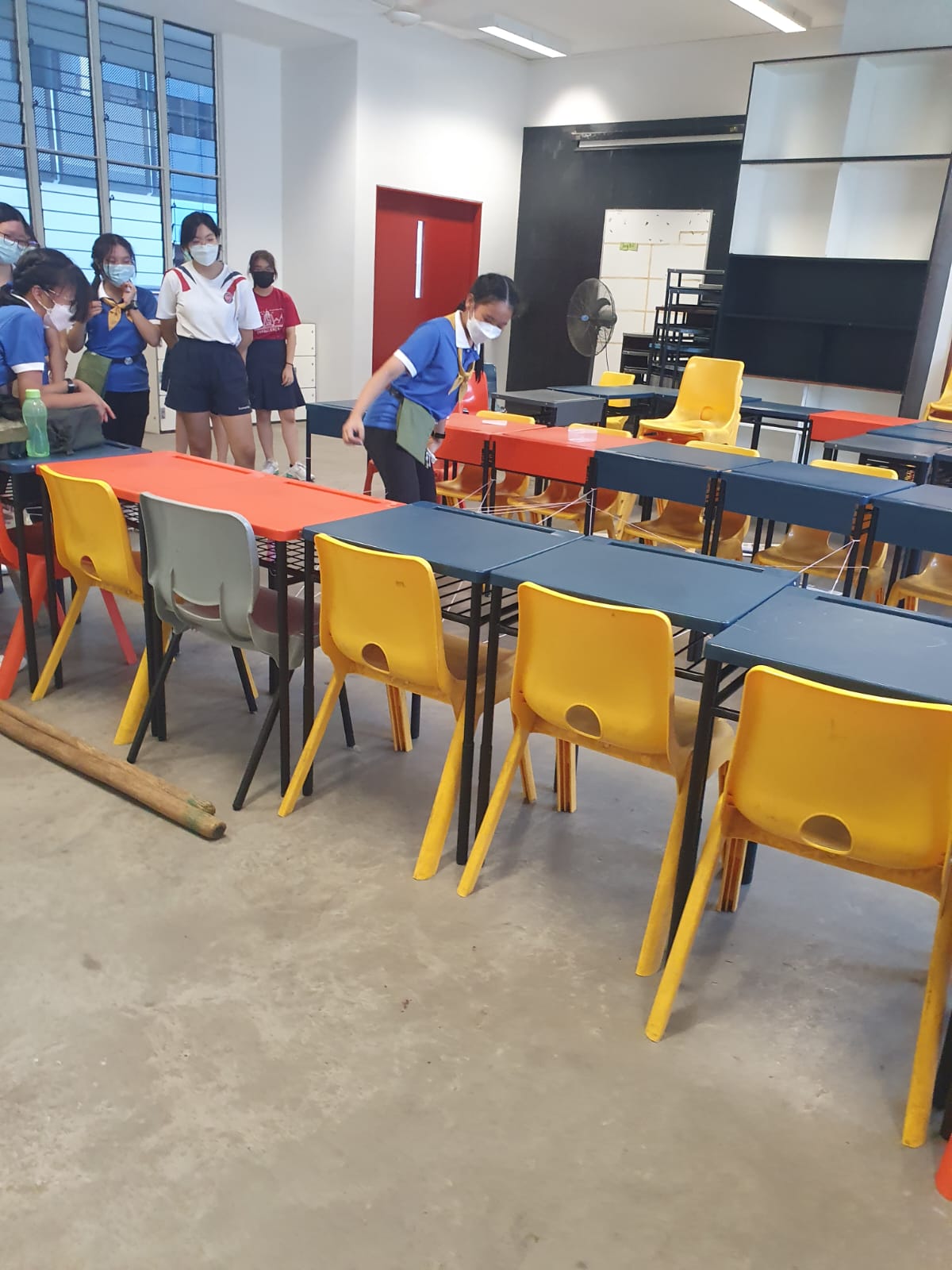
For this station, the juniors had to cross the obstacle course including: a raffia string maze, crawling under the tables, and stepping on only the newspapers to cross the "river". This station aims to promote patrol bonding and also helps them work together, as they can guide each other through the obstacle course and encourage each other.
Reflection from a Year 1:
The obstacle course station was very fun and I would love to play it again. But at the same time, it was also quite challenging since there were rules that we had to abide by. Since we could not touch the strings at any point of the game, we had to think outside the box to overcome the challenge and complete the station. One of my patrol mates had an idea of sliding under the strings as there was a small gap between the floor and the strings. While it was a creative idea, it was not successful and we had to find alternative ways, the simplest was walking inside the holes between the strings. Since some of the gaps were rather small, we still ended up touching the string and it was also difficult to balance. When it was time to crawl under the tables, it was a little less challenging, but since there was so little space, it was very cramped and difficult to move around. We also had to wait for the person in front of us to move before we could continue. It was important that we did this carefully to prevent ourselves from hitting the tables, hence, resulting in a longer time to complete the activity. From this particular obstacle, I learnt that patience is very important. The seniors ended up cheering for each other and we ended up finishing the whole obstacle course a lot earlier than planned. From this activity, it definitely taught me many things. For example, I learnt that cooperation with teammates is very vital, and slow and steady wins the race, since we had to be careful and do things slowly to refrain from touching the strings. I felt that it was a very memorable activity and I enjoyed it very much.
Reflection from a Year 2:
We had Obstacle Journey during our 集合 and in station 3, we had to attempt an obstacle course that involved getting past a raffia string maze without touching the strings, stepping on newspapers to cross the “river”, and crawling under tables. At first glance, it did not require much teamwork, besides the fact that the obstacle course is only complete once everyone crosses it. When I tried it out with my patrolmates, however, I realized that we had to cooperate, such as moving at a suitable pace so that everyone could catch up. The person in front could not go too fast, as that may cause the people behind them to feel anxious and mess up the group’s rhythm. I enjoyed the activity, as it had been a long time since I had participated in an activity like obstacle courses with others. I also thought that it was quite creative. The part where we had to get past the raffia strings without touching them taught me the importance of thinking before going headstrong into something. I had to look around and identify the strings that are lower in height, so that I could get my legs over without touching them. However, I was unsure whether I had actually touched the strings so I did not know how effective my strategy was. For the part where we had to step on newspapers to get across the "river", I had to take note of the patrol mate in front of me, and check with them whether they were ready to step off the piece of newspaper I wanted to step on so we would not both step on the same piece and fall off. For the last part, I learnt to go slowly but steadily so that my back would not hit the tables.
Reflection from a Year 3:
For this station, we had to go through an obstacle course which included first going through an obstacle without touching the raffia strings that were tied across the tables, then crossing a “river” by using newspapers as stepping stones, and finally crawling under the tables to make our way out of the obstacle course. For the raffia string obstacle, we learnt to be more cautious of our actions and also to be observant and look out for where we are heading as these were important skills we needed to have so as to not touch the raffia strings. Even though there were no forfeits for touching the raffia strings, we still treated the course seriously and tried our best not to touch any string. The raffia string part was the hardest to complete, as they were tied quite high up and we were not allowed to go underneath it. For the second part of the obstacle course, we were able to hone our movement and agility skills as we needed to be able to change directions quickly while stepping on the newspapers in order to cross the “river”. This would improve our physical aspects and help us gain better control and balance over our body. The last obstacle was to crawl under the tables to make it out of the obstacle course. For this activity, we looked out for one another so that we would not bump into the tables or into each other while crawling. This is also in relation to 照顾好人,照顾好东西, as we should look out for others in order to make sure everyone is doing well. We also 等人 to make sure no one is left behind, before moving on to the next part of the obstacle course. We had a lot of fun in this activity, so our morale was high, and in the end we managed to complete the obstacle course early.


Station 4: Pioneering Self Supporting Bridge
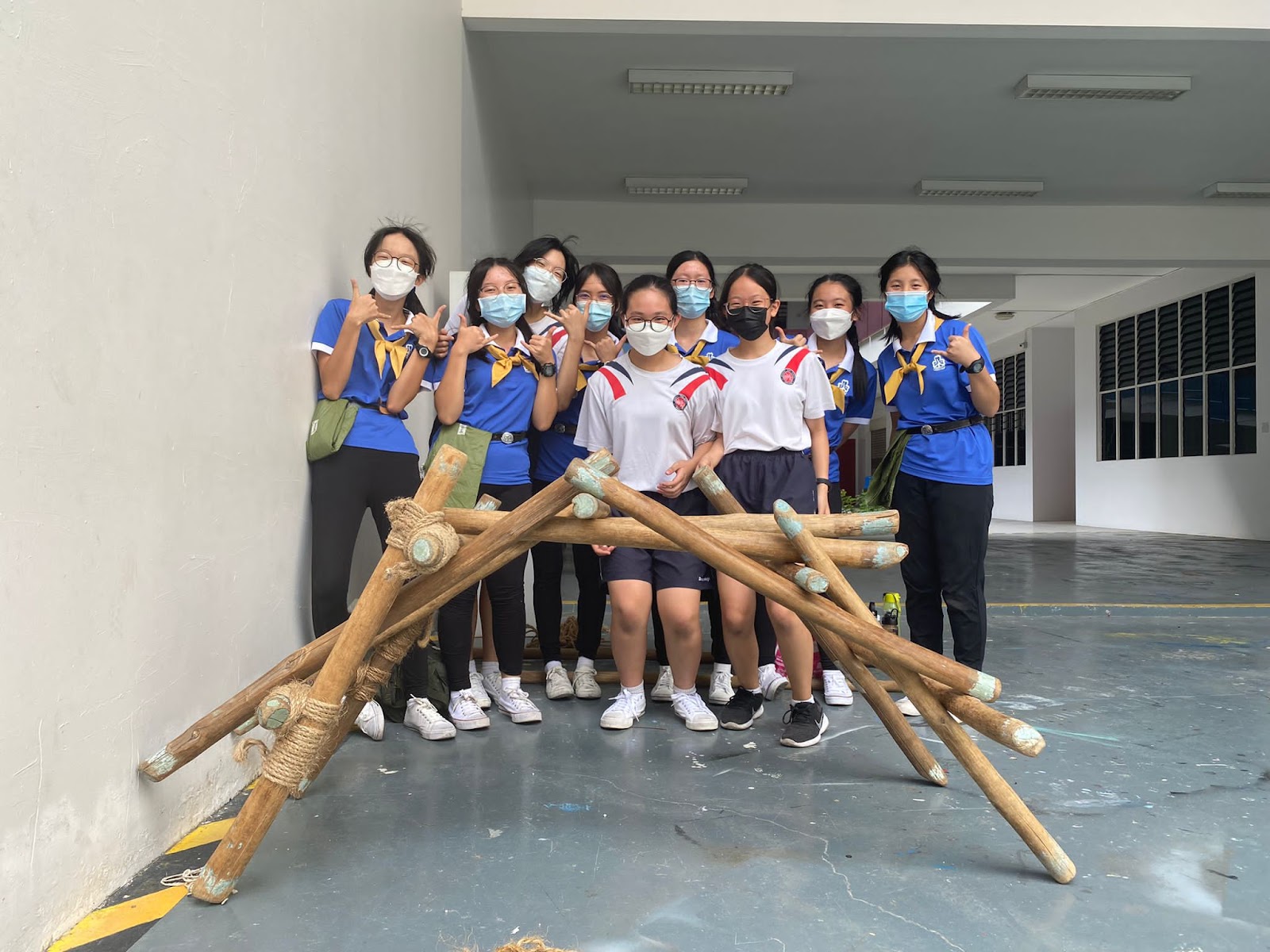
For this station, the juniors had to construct Leonardo Da Vinci's Self Supporting Bridge with spars. This bridge involves no tying, however, it focuses on the placement of each and every single 木 to support each other which allows it to stand. A PL and PS had to step up to give instructions to the patrol on how to place the 木. This trains them to pay more attention to small details and communicate the instructions clearly to the patrol, helping them work together to construct the bridge.
Reflection from a Year 1:
For station 4, the activity was to build a bridge with only 浅蓝木, and no 麻绳. I think this activity was quite challenging because usually, when building structures, we use square lashes to secure two 木 together. A blueprint was given to the PL to help guide us to build the structure, which was a bridge. This required a lot of teamwork, perseverance and coordination, so as to not let the bridge collapse. Together as one patrol, we had to learn the importance of good communication. We also learnt about perseverance as we continued to try again without giving up despite the bridge falling down many times. The activity was really fun because we definitely learnt more about teamwork and coordination between our patrol. Even though our structure did not succeed in the end, I believe that we all had a really fun time together.
Reflection from a Year 2:
On the 31st of May, we had our last 集合 with the Year 4s before the Passing Down Parade. During that 集合, we took part in many activities, one of which being Obstacle Journey. During Obstacle Journey, there were many stations that improved our soft skills and hard skills and helped us improve as a patrol. However, the last activity was the one that I remembered most vividly, the building of a self-supporting bridge. This activity consisted of us having to build a bridge solely using the materials we were provided with. This included 4 浅蓝木s that were tied into the shape of a square and 8 to 10 other 浅蓝木s. With only these logistics, we were to build a self-supporting bridge. However, only the Patrol Leader and Patrol Second of that station were able to see the instructions on how to build the bridge and they were to stand 1 metre away from the structure at all times. To build the bridge, we had to weave the 浅蓝木s together and thus it required every one of us. Some had to insert the 浅蓝木s while others had to support the 浅蓝木s. Since using 麻绳 was supposed to act as the last resort, we did not use it. Although we were unable to build the structure, we still had a fruitful experience as we learnt that everyone in the patrol played a key part as seen from even if only one person was missing the entire structure would fall apart thus everyone had an important part to play in the building of the bridge. This would also be one of the last things we would be able to build with the Year 3s and the last time we would be able to have a 集合 with the Year 4s as the Year 3s will be stepping up to lead the company while the Year 4s will be stepping down.
Reflection from a Year 3:
Through this station, we had to put together a bridge using as few 麻绳 as possible with the given spars. With the appointment of one Y3 as the PL and Y2 as the PS who were the only ones who could see the diagram and instructions on how to build the bridge. I learnt the importance of teamwork, leaders working together, communication, decision making and perseverance. Communication from the PL to the rest of the patrol on where to put the various spars, and how to hold the bridge together. Throughout this, both PL and PS had to communicate and work together to lead our patrol to finish our bridge within the time limit. Teamwork of putting together and holding the spars up in order for the bridge to stay together. If one person were to let go of the spar, the entire structure would fall. This is akin to how every member of a team is important, and without the support of one, everything would fall. This was followed by decision making of where to put the few respective 麻绳. Throughout this process, our bridge fell countless times due to a few mishaps. This resulted in the structure collapsing and thus going back to square one. From the beginning, having the determination to rebuild the bridge till it stayed. We cheered as a patrol, keeping our morale high. This station not only gave us an interesting insight on our soft skills but also hard skills. We learnt how a structure could have only 2 麻绳 and support the entire thing and how to overlap and choose the different lengths of the spars in order to angle the bridge so it stays together. Overall, this station allowed us to learn about spars, stepping up, leadership, working together, communication and perseverance.


Station 5: Gadgeting Carousel
For this station, the juniors were required to construct an unconventional gadgeting structure, the Carousel. This structure makes use of a table to stabilise itself, and also a PVC pipe to allow it to spin. Hence, the juniors will learn that gadgeting structures can come in many forms, and can also involve making use of the surrounding objects. This station also allows the Year 2s to step up and give clear instructions to the patrol on how to construct the carousel.
Reflection from a Year 1:
For this activity, I volunteered to be the Year 1 PS. I got a chance to try to lead the patrol to construct the carousel. While we did the activity, I thought about what the seniors always reminded us of, manpower allocation. I think that throughout the activity, the Patrol Leader for the activity, a Year 3, and I tried our best to find things for our patrol mates to do. She was definitely better at explaining what needed to be done, but she encouraged me to guide the patrol in some parts. At one point, we were looking at the picture of the structure given by our senior, and we realised that we had gotten one part wrong. We were supposed to tie two mickey-mouse lashes in the middle of the structure but we had tied something else instead. Thankfully, we were able to spot the mistake and correct it in time. The last part of the structure was making the “seats”. Because we were missing one short-half bamboo, the structure was unbalanced. When the activity ended, our Year 4 senior said that she had seen some confusion in our patrol mates and suggested that next time, we could verbally explain the brief overview of the structure. Although it was short, I found it an enriching experience.
Reflection from a Year 2:
During Tuesday's 集合 Station 5, we had to build a carousel with the help of an upturned table. We had to tie 麻绳 around the 长木 and frap it around the legs of the table until it will stand by itself. However, instead of using clove hitch we could have chosen to use mickey mouse lash instead as it would be easier and more stable. When others are working on the PVC pipes, we should not stand there doing nothing, but instead we could have frap the 麻绳 around the table legs more tightly as the 长木 started to fall at the end as it is very important and the base of our structure. The 短木 that is tied to the PVC pipes must be tied looser so that it could go up and down like a carousel. We also adopted well by using a marker as a carousel seat as we do not have enough 短木 as seats. Even though I was not the PL or PS I could also learn from them, like one can take care of the base and the carousel seats while one can look over the making of the spinning thing of the carousel to make everything more efficient and clear. One thing I think my patrol did well is that we completed the activity very quickly and were able to find time to tuck in the 鸟绳. Overall, the whole structure is a very nice and creative one as we never made a carousel before. Despite all the difficulties we faced, we were still able to complete the structure well in the given time and we greatly enjoyed the process.
Reflection from a Year 3:
During Station Games, there was a Creative Gadgeting station where we had to build a carousel. In this activity, I stepped up to be the Patrol Leader, the only person who was able to see the drawing. When I first saw it, I found that the idea was very innovative as it made use of the flagpole base and a PVC pipe to allow the structure to stand and be able to spin. In the beginning, there were quite a number of zuobos as only one person could tie the 中短木 to the 长木. To solve this, I tried to allocate manpower to tie clove hitches onto the 中短木s for the flying parts. However, this backfired at the end of the building of the structure because I had missed out the minor details of how the flying parts were to be attached. This taught me to be more attentive and careful to these small details that could result in wasted time and unnecessary work. Additionally, another major hiccup occurred during the 抽-ing of the structure to tie it against the table. Excessive and insufficient tension on different sides caused the structure to be tilted and unstable. From this, I learnt to calmly step out and look at the bigger picture, even when we are running out of time. Overall, I feel that one room for improvement would be the time management and sense of urgency as at the start of the allocated 15 min we were not really able to accomplish much. This resulted in insufficient time for 抽-ing of the structure, which should have been the priority, because it allows the overall structure to stand. In all, I feel that the creative carousel idea was very creative and interesting and is something I hope to build again, but improved. Nevertheless, through this activity, I learnt to zoom in and zoom out, by paying attention to seemingly minor details as well as looking at the big picture.


Station 6:Orienteering and Puzzles
For this station, the juniors had to take compass bearings and take the number of pacings specified on the post-its, to lead them to the location of the puzzle. They then solved the puzzle as a patrol. This station helped the juniors to recap on their compass reading and orienteering skills. For the Year 1s, they could learn how to take the compass bearings and the different types of pacings, such as single and double pacing. This station also promotes patrol bonding as they work together to solve the final puzzle.
Reflection from a Year 1:
We had OJ during our last CCA session before PDP. One of the stations was about orienteering and puzzles. We had to use the compass to find the puzzle pieces. I learnt how to use the compass to find directions. The compass is to be held flat in the palm and hold the palm in front of the chest. The way the red point on the compass needle is facing is the magnetic north. Then I had to rotate the bezel, a grooved ring holding the cover of the compass, so that the orienting arrow was pointing towards the magnetic north. The direction where the direction-of-travel arrow aligns with the degree shows the way I am supposed to walk in to find the puzzle pieces. I also learnt what single pacings and double pacings are. One single pacing is the distance of one foot while one double pacing is the distance of two single pacings. We took turns to use the compass to find the puzzle pieces so that we could finish the puzzle. I think learning how to use a compass is important because even though there is GPS, navigating by compass has become something of a lost art. Through this activity, my patrol has managed to bond closer together as we tried to make use of the compass to locate the puzzle pieces. I also feel that we could have 报时-ed and cheered more to boost our patrols morale. In the end, we managed to find all the puzzle pieces and we successfully assembled them to form the picture. I was very happy that I remembered how to use a compass and I was able to accurately reach the appointed location. All in all, I enjoyed this station very much and I hope that we can have more of such activities in future Obstacle Journeys.
Reflection from a Year 2:
During the orienteering and puzzles station, we used a compass to find the location of the pieces to a puzzle and pieced them together to form a picture. I feel that the activity was a fun way to allow us to learn how to use a compass to navigate and find our way around. It is important to know how to use a compass, as it can help us find our way when we get lost and do not have access to apps such as Google Maps. It also taught us to be systematic as we had to start with puzzle piece 1 and go according to the order until we found all the pieces, or else we would not get all the puzzle pieces. Although we did not know how to use a compass at first, we slowly got the hang of it and managed to find all the puzzle pieces. There were also a few times where we got to the wrong place as we did not navigate properly. Teamwork was also key to helping to find the puzzle pieces as we only had the rough location of the puzzle and it could have been on the table, chairs or anything near. While piecing the puzzle together, we also had to work together to find the correct puzzle pieces to put in each spot. We had a few puzzle pieces that were in the wrong place, but we eventually managed to figure out their correct placement as the end product of the puzzle looked weird. Even though it took us quite some time to do this activity, we had fun and managed to learn how to use a compass properly. I really hope that we have more activities of this type as we had fun while learning new things.
Reflection from a Year 3:
For this station, we had to use our orienteering skills such as using a compass and taking single and double pacings. Since we had to find the post-its in order, we had to use the compass to navigate and not just go around looking for the post-its without using the compass. We were not sure how to use the compass at first, since it has been a long time since we used the compass and we were not able to revise it enough. However, after the seniors had explained to us and we tried a few times, we managed to get the hang of using the compass. Using this skill, we were able to find all the post-its successfully. After we found all the post-its, we had to solve a mini puzzle. All of us contributed to putting the pieces of the puzzle together. This also gave us a chance to bond as a patrol and have fun together. The puzzle was slightly difficult at first because the picture was really complicated with a lot of details, but after working together to put the corner pieces at the correct place, we managed to gradually figure out how to fix the rest of the pieces. Interestingly, puzzles also symbolize how putting all the right pieces together allows us to look at the bigger picture, which is an important skill that we need to have as Guides - to be able to look at the bigger picture. Through this activity, we learnt how important and useful orienteering skills are. We should revise and put our skills into practice as much as possible, so that we would not forget our orienteering skills and continue to be able to complete such stations successfully in the future.

We hope that everyone enjoyed today’s 集合 and learnt something new!
Published by:
Pok Jing
53 届 Secretary

.jpeg)
.jpeg)

.jpeg)
.jpeg)


.jpeg)


